Platform guide
How the Instagram algorithm ranks video (what Instagram has actually said)
Short answer
There is no single Instagram algorithm: Instagram says Feed, Stories, Explore and Reels each have their own ranking system, and Meta publishes a system card for each. For Reels, Meta says the system narrows candidates to about 100 and scores them with predictions such as how likely you are to watch more of a reel than 95% of the people who watched reels of the same length. Instagram also says it makes watermarked, low-resolution and already-posted reels less visible, and since April 30, 2026 accounts that mostly repost others' photos, carousels or reels are not recommended.
Key takeaways
- Instagram names different signals per surface. Reels lean on your activity, your history with the poster, information about the reel (audio, visuals, popularity) and information about the poster.
- Explore is where post popularity matters most. Instagram says how many people like, comment, share and save a post, and how quickly, matters much more in Explore than in Feed or Stories.
- Originality is an official rule, not folklore. Unoriginal content that is largely repurposed with only minor edits is not eligible for recommendations, and adding only a border, watermark, subtitles or a credit does not make it original.
- Instagram has not published weights, a posting time that helps, a hashtag count or an ideal reel length. Anything claiming those is not confirmed by Instagram.
- You can see and change your own topics in Your Algorithm, now live across Feed, Reels and Explore (Instagram update of June 10, 2026).
- Instagram publishes no good or bad value for skip rate, retention or average watch time. It defines the metrics, so compare your own reels with each other.
How does the Instagram algorithm work?
Instagram's own description is that "each part of the app, Feed, Stories, Explore, Reels, Search and more, uses its own algorithm tailored to how people use it" (Adam Mosseri, May 31, 2023). Meta's Transparency Center repeats the same structure in its newer system cards: gather candidate content, apply integrity and guideline filters, run a lightweight model to shrink the pool, make predictions about what you will do with each item, then rank by score.
Both sources say the inputs change. The Reels card, updated November 11, 2025, says the models and their input signals "are dynamic and they change frequently as the system learns and improves over time." For Feed, Instagram says there are "thousands" of signals, so any list of them, including ours below, is a sample of what Instagram chose to publish, not the whole system.
Which signals does Instagram name for Feed, Stories, Reels and Explore?
The table lists only what the cited pages say. Meta's cards show an "updated" date, and Instagram's 2023 post shows its publication date; both are in the last column. Order inside a cell follows the source where it says "roughly in order of importance."
| Surface | Signals Instagram names | Source and date |
|---|---|---|
| Feed (accounts you follow) | Your activity (posts you liked, shared, saved or commented on); information about the post (how popular it is and how quickly people like, comment, share and save it, when it was posted, location); information about the person who posted (for example how many times people interacted with them in recent weeks); your history of interacting with that person. In Feed, the five actions Instagram says it watches most closely are how likely you are to spend a few seconds on a post, comment, like, share, and tap the profile photo. | Mosseri, "Shedding more light on how Instagram works", May 31, 2023; Meta Transparency Center, Instagram Feed, updated Jun 29, 2026 |
| Feed predictions on the system card | Swiping through a whole carousel, enjoying the post, skipping it, time on the author's profile after seeing it, sharing it in a direct message, time spent on the post, turning the sound on for a video. Named inputs include photo, video or carousel type, text overlaid on a photo, and, for shares, whether the post is informative (news, product reviews, tutorials, how-tos) and created within 90 days. | Meta Transparency Center, Instagram Feed, updated Jun 29, 2026 |
| Stories | Viewing history (how often you view an account's stories); engagement history (for example sending a like or a DM); closeness (your relationship with the author). Predictions: how likely you are to tap into a story, reply, or move on to the next one. | Mosseri, May 31, 2023; Meta Transparency Center, Instagram Stories, updated Sep 18, 2025 |
| Reels | Your activity (reels you liked, saved, reshared, commented on); your history of interacting with the person who posted; information about the reel (audio, visuals, popularity); information about the person who posted (such as follower count and engagement level). Most important predictions per Instagram: reshare, watch all the way through, like, and go to the audio page. | Mosseri, May 31, 2023 |
| Reels tab (system card) | Inputs include reel length, similarity to other reels and how well a reel matches what you interact with. Predictions named: likelihood you watch more of a reel than 95% of the people who watched reels of the same length; watch less than 3 seconds; comment; click "Interested"; use the reel's audio in your own; open a tall reel in Explore full screen. Named signals include how long people have watched the reel, how many times it was viewed with sound on, and how many times it was skipped within two seconds. | Meta Transparency Center, Instagram Reels Chaining, updated Nov 11, 2025 |
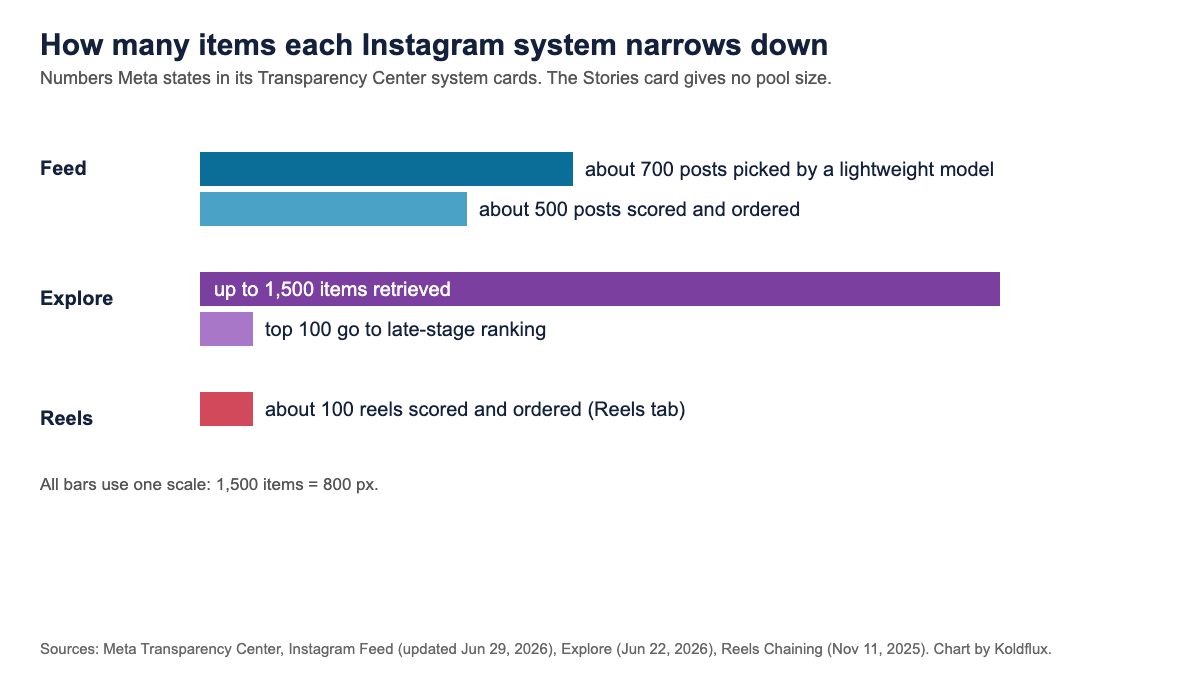
| Explore | Information about the post (how many and how quickly others like, comment, share and save it); your activity in Explore; your history with the poster; information about the poster. Three stages: retrieval (up to 1,500 items), early-stage ranking (top 100), late-stage ranking by likelihood of engagement such as like and save. Predictions named: follow the author, spend more than five seconds on a post, watch more than 95% of a video, click "Not interested". | Mosseri, May 31, 2023; Meta Transparency Center, Instagram Explore, updated Jun 22, 2026 |
Read October 21, 2026.
One signal is a measurement rather than a creator action: Instagram says that in Reels it surveys people and asks whether a reel was "worth their time" or fun, and learns from the answers (Mosseri, May 31, 2023).
Meta's Transparency Center explaining-ranking index lists further system cards for other experiences; they are not covered here.
How does the Instagram Reels algorithm work, step by step?
Meta's Reels card describes four steps: gather inventory, leverage signals, make predictions, rank reels by score.
- Gather inventory: reels from accounts you follow, and reels similar to those you recently engaged with.
- Leverage signals: the system looks at inputs such as reel length, similarity to other reels and match to what you tend to interact with. A lightweight model keeps about 100 of the most relevant reels, and integrity processes remove content that is non-recommendable or may go against Community Guidelines.
- Make predictions: models estimate what you will find relevant and valuable.
- Rank by score: about 100 reels get a relevance score, and reels predicted to provide more value are shown sooner.
Instagram's 2023 post adds that in Reels "the majority of what you see is from accounts you don't follow", and that the emphasis is entertainment. The post also lists follower count and engagement level among poster signals "to help find compelling content from a wide array of people and give everyone a chance to find their audience."
Does Instagram favor original content, and what counts as original?
Yes, and the rule is written down. On April 30, 2026 Instagram extended its 2024 reel protections to photos and carousels: accounts that primarily post unoriginal content in photos, carousels or reels "will no longer be shown in places where we recommend content." The change does not affect how people see content from accounts they follow, and it is separate from Instagram's intellectual property policies. Instagram says 75% of recommendations in the US now come from original posts.
Instagram's examples of original content: photos or videos you took, content you designed, and content you materially edited, such as adding unique text that gives more context than describing what is happening, creative graphics that offer new information, or using the remix feature to transform the original. What does not qualify: re-uploading someone else's work without meaningful creative input, "such as just adding a border, watermark, subtitles, or a credit in the captions."
A flagged account can become eligible again "when most of their recently posted photos, carousels, and reels are considered original in a 30-day period," calculated on a rolling basis. Check Account Status in settings, where you can also appeal. Instagram's suggested alternatives to reposting: collabs, remix, the paid partnership label, sharing to Stories, or reposts.
The Recommendations Guidelines on Instagram's Help Center list "unoriginal content that is largely repurposed from another source with only minor, immaterial edits, without adding material value" among low-quality content that may be allowed on Instagram but not eligible for recommendations. That page also names long captions unrelated to the content and coordinated comment networks that drive engagement artificially.
Do watermarks, low resolution or borders hurt reels?
Instagram states it: "We aim to make certain reels less visible for other reasons, such as low-resolution or watermarked reels, reels that are muted or contain borders, reels that are majority text, or reels that have already been posted on Instagram" (May 31, 2023). In the same post Instagram said it was testing notifications to tell creators when a watermark may be limiting a reel's reach.
What Instagram has not said on the pages we read: the size of the effect, whether a watermark of your own brand is treated differently from another app's, or the exact resolution that counts as low. We do not state those as facts. The practical reading is narrow: export without another app's logo, at the resolution the original was shot, and do not rely on a border or burned-in credit as your "edit". See our guide to Reels sizes and safe zones for dimensions Instagram has published.
What does Instagram say it does not do?
Three statements in the May 31, 2023 post: Instagram does not use one algorithm for the whole app; it says "we don't suppress content to encourage people to buy ads"; and it says its ranking is not meant to limit or hide an account or content without a clear explanation, which it ties to community concerns about "shadowbanning." It also says that if you repeatedly break the Community Standards you may lose certain features, which is different from a hidden penalty.
The Recommendations Guidelines say Instagram works to avoid recommending content that is low-quality, objectionable or sensitive even when it is not severe enough to remove, because it applies stricter standards to accounts people have not chosen to follow. Accounts may also not be recommended if they recently violated the Community Guidelines or repeatedly engaged in misleading practices to build a following, such as buying likes.
Can you see or change what the Instagram algorithm shows you?
Yes. Instagram launched Your Algorithm on December 10, 2025, and on June 10, 2026 said it is live across Feed, Reels and Explore, globally in English. Tap the icon with two lines and hearts in the upper right of Reels or Explore to see an AI-generated summary of topics shaping your recommendations, add or remove topics, and tell Instagram you want more or less of something. Posts recommended from a topic can carry a label such as "From Running."
The Transparency Center cards also list controls: Not interested, Following (reverse chronological feed), Favorites, mute, hide, report, and sensitive content settings. For creators this means your reach also depends on audiences choosing topics, which Instagram has not quantified.
What has Instagram not confirmed about the algorithm?
Common advice that did not appear on any Instagram or Meta page we read. Treat each as not confirmed, not as false:
- Exact ranking weights, for example that shares count a fixed multiple of likes. Instagram's pages list signals, not weights.
- That watch time, likes and sends are the top three signals. No Instagram or Meta page we read states this, so we do not repeat it as fact.
- A best time or day to post. Meta's cards list how recently a post was created as an input for some predictions, but give no time of day. See our best time to post guide for data, which is a separate question.
- A hashtag count, keyword in captions, or reel length that ranks better.
- That editing a caption, deleting a post or posting often changes reach.
- A hidden first-hour test that decides a reel's fate.
- Universal benchmarks, such as a healthy skip rate percentage or a target average watch time.
What should I do with this?
Pick the situation that matches your numbers. Each step is tagged "Official" when an Instagram or Meta page we read states it, or "Our suggestion" when it is our reading and not an Instagram statement. Instagram publishes no weights and no target numbers, so none of the steps promise a result.
| Situation | Official (Instagram or Meta states it) | Our suggestion (not an Instagram statement) |
|---|---|---|
| 1. Low views, but people who start watching keep watching | Reels shows mostly accounts people do not follow, and the system picks about 100 candidates per person before scoring (Meta Reels card, Nov 11, 2025; Mosseri, May 31, 2023). Instagram says it aims to show watermarked, low-resolution, muted, bordered, majority-text and already-posted reels less (Mosseri, May 31, 2023). Views count each start or replay; accounts reached counts unique accounts that saw the reel on screen (Instagram Help Center, reel insights, undated). | Compare accounts reached with views to see whether the same people replay it. Check the reel against the list on the left. Then judge it against your own last reels of similar length, since no public number says what "low" is. Change one thing per reel, such as the topic or the first frame, so you can tell what moved. |
| 2. Low retention in the first seconds | Instagram's Retention chart shows the percentage of views still watching at each moment, and skip rate is "the percentage of views from people who decided to skip your reel during those first 3 seconds" (Instagram Creators account, Aug 22, 2025, wording as reported by Social Media Today, Aug 24, 2025). Instagram publishes no reading rule for the chart's shape. Meta's Reels card names "watch less than 3 seconds" and skipping within two seconds among its predictions and signals. | Open the Retention chart of a reel that lost viewers early and note the second where the drop starts. Put the payoff or the question in the first frame, cut slow lead-ins, and keep text out of the bottom 35% (see the checklist). Compare skip rate between your own reels, not with other accounts. |
| 3. Reach dropped and you wonder about recommendation eligibility | Since April 30, 2026 accounts that primarily post unoriginal photos, carousels or reels are not shown where Instagram recommends content; followers still see the posts. Eligibility can return when most recent posts are original "in a 30-day period," on a rolling basis. Account Status in settings shows the state and lets you appeal (Instagram for Creators, Apr 30, 2026). Accounts may also not be recommended after recent Community Guidelines violations or misleading practices such as buying likes (Recommendations Guidelines, Help Center). | Open Account Status first. If it shows nothing, treat the drop as ordinary variation and check the reel-level causes in situation 1 before changing your whole style. If it flags you, stop posting reposts and count 30 days from your first original post. Instagram does not say that deleting old posts or changing captions helps, so we do not suggest it. |
Sources read October 21, 2026.
Where this stops: Instagram does not say which of these changes will move your account, how long a recovery takes, or what share of viewers should stay past the first seconds.
How do I read Instagram Insights without universal benchmarks?
Plainly: on the Instagram and Meta pages we read, Instagram publishes no good or bad value for views, skip rate, retention or average watch time. Any article that gives "30% is healthy" style cutoffs is not citing Instagram, so we list them as not confirmed. What Instagram does publish is what each number means.
| Metric | Instagram's definition | How to read it (our suggestion) | Published benchmark |
|---|---|---|---|
| Views | The number of times your reel starts to play or replay. | Counts replays, so one person can add several views. Read it next to accounts reached. | None found |
| Accounts reached | Unique accounts that saw your reel on screen at least once, whether or not it was played. Instagram marks it as estimated and in development. | Treat it as an approximate count. A big gap between views and reach means a lot of replays. | None found |
| Watch time | The total time your reel was played, including replays. | Grows with views and length, so it cannot be compared between reels of different length on its own. | None found |
| Average watch time | Watch time divided by the number of initial views; an initial view is the first time the reel starts to play in a reel session. | Divide by the reel length to compare reels of different length, and compare only your own reels. | None found |
| Retention chart | The percentage of views from people who continued to watch at each moment; (Instagram Creators account, Aug 22, 2025). Instagram gives no further reading rule. | Look for the second where the line falls fastest and edit that part of the next reel. | None found |
| Skip rate | The percentage of views from people who decided to skip the reel during the first 3 seconds (Instagram Creators account, Aug 22, 2025). It replaced view rate. | Compare it between your own reels that start differently. A lower value on a similar topic suggests a better opening. | None found |
What Instagram says each reel metric means, and how to read it without a benchmark.
The Help Center definitions page is undated; Instagram's text for views, watch time, accounts reached and average watch time was read from an Internet Archive snapshot of that page in 2025 on October 21, 2026. Menu names inside the app may have changed since, so confirm the labels in your own Insights.
What should I check before publishing a Reel?
Use this list on every upload. "Official" means Instagram or Meta states the rule; "Our suggestion" means it is our practice, not a rule.
- Original content (Official): is the footage yours, or materially edited with new context? Re-uploading others' work with only a border, watermark, subtitles or a credit does not count as original (Instagram for Creators, Apr 30, 2026).
- No watermark from another app (Official): Instagram says it aims to make watermarked reels less visible (May 31, 2023). Export from your editor without another app's logo. Our suggestion: keep an export without any logo as your master file.
- Aspect ratio 9:16 (Ads guide only; organic Reels not documented): Meta's Ads Guide for Instagram Reels recommends 9:16 at 1440 by 2560 pixels. For organic reels Instagram did not publish a separate page we could read, so we apply the same ratio. Our suggestion: crop a landscape clip to 9:16 instead of leaving borders, because borders are on Instagram's less-visible list.
- Resolution (Official): low-resolution reels are on the same less-visible list; Instagram gives no minimum number. Our suggestion: export at the resolution you shot, not a downscaled copy.
- Safe zones (Ads guide only; organic Reels not documented): Meta suggests leaving at least 14% of the top, 35% of the bottom and 6% on each side free of text and logos. Our suggestion: apply it to organic reels too, and check your frame with the safe zone overlay.
- Sound and captions: Instagram lists muted reels and majority-text reels as less visible (Official). Our suggestion: use real sound, add captions for viewers who watch without it, and keep the text short so the picture is not mostly words.
- Do not post what is already on Instagram (Official): already-posted reels are on the less-visible list; use collabs, remix or Stories sharing instead of reposting.
If views stay low after the checklist, our troubleshooting guide for Reels not getting views covers causes step by step.
Free tools:Instagram Reels safe zone overlayCrop video to 9:16Add captions to a video
Do it in your browser
Free Koldflux tools, no account needed.
Questions people ask
Is there one Instagram algorithm?
No. Instagram says Feed, Stories, Explore, Reels and Search each use their own algorithm, and Meta publishes a separate system card for each.
What does the Instagram Reels algorithm look at?
Instagram names your activity, your history with the poster, information about the reel such as audio, visuals and popularity, and information about the poster. Meta's Reels card adds reel length and predictions such as watching more of a reel than 95% of the people who watched reels of the same length, which are labeled as examples of significant predictions.
Do reposted or watermarked reels get less reach?
Instagram says it aims to make watermarked and already-posted reels less visible, and since April 30, 2026 accounts that mainly post unoriginal photos, carousels or reels are not eligible for recommendations. Followers can still see the content.
Does Instagram suppress content to make you buy ads?
Instagram states in its May 31, 2023 post that it does not suppress content to encourage people to buy ads.
Can I reset or change my Instagram algorithm?
You can edit topics in Your Algorithm (the two lines with hearts icon in Reels or Explore), use Not interested, and switch to Following or Favorites for an order not based on recommendations. Instagram's pages we read do not describe a full reset.
What is a good skip rate or retention on Instagram Reels?
Instagram has not published one. It defines skip rate as the percentage of views that skip the reel in the first 3 seconds and shows a Retention chart of how many views keep watching. Compare your own reels with each other. Cutoffs quoted elsewhere are not confirmed by Instagram.
My reel has low views but good retention. What should I check?
Check Account Status, then the reel for a watermark from another app, borders, low resolution, no sound or mostly text, all of which Instagram says make reels less visible. Instagram does not say how many views to expect, so compare with your own recent reels.
Does Instagram say when to post?
No time of day appears on the Instagram and Meta pages we read. See the best time to post guide for audience data, which is not an Instagram statement.
Related
Sources and how we checked
- Instagram (Adam Mosseri): Shedding more light on how Instagram works, May 31, 2023 (checked 2026-10-21)
- Meta Transparency Center: Instagram Reels Chaining, updated Nov 11, 2025 (checked 2026-10-21)
- Meta Transparency Center: Instagram Feed, updated Jun 29, 2026 (checked 2026-10-21)
- Meta Transparency Center: Instagram Stories, updated Sep 18, 2025 (checked 2026-10-21)
- Meta Transparency Center: Instagram Explore, updated Jun 22, 2026 (checked 2026-10-21)
- Instagram for Creators: Rewarding original creators on Instagram, Apr 30, 2026 (checked 2026-10-21)
- Instagram Help Center: Recommendations on Instagram (undated page) (checked 2026-10-21)
- Instagram Help Center: View insights on your Instagram reels (undated; text read from a 2025 Internet Archive snapshot) (checked 2026-10-21)
- Instagram Creators on Threads: new Retention chart in reel insights, Aug 22, 2025 (checked 2026-10-21)
- Social Media Today: Instagram adds retention insights for Reels, Aug 24, 2025 (reports Instagram's wording on skip rate; secondary source) (checked 2026-10-21)
- Meta Ads Guide: Instagram Reels video specs (9:16, 1440 x 2560; safe zones), undated (checked 2026-10-21)
- Instagram: Introducing a new way to see and control your algorithm, Dec 10, 2025 (updated Jun 10, 2026) (checked 2026-10-21)
We read the Instagram and Meta pages above in a browser on October 21, 2026. Meta's cards show an updated date; Instagram's creator pages and the Help Center page do not, so those dates are the posting dates or the date we read them. We quote only Instagram and Meta. We also read the Meta Ads Guide for Instagram Reels (aimed at ads) and the Instagram Creators account post of August 22, 2025; the exact skip rate wording is quoted from Social Media Today's report of Instagram's text. Where we mark a step "Our suggestion" it is our reading, not an Instagram statement. Third-party advice is not used as a source, and where a claim circulates without an Instagram page behind it we list it as not confirmed. Instagram and Meta are trademarks of their owners. Koldflux is not affiliated with or endorsed by them.